
EU VAT reportRates in force on 23 November 2026Source: European Commission, TEDB
How much VAT is charged in Netherlands?
VAT in Netherlands
21%
Standard rate · in force on 23 November 2026
- Rates taken from the EU tax database
- Works without an account
- Sums are done on this page as you type
- All 27 EU countries plus the UK
- 1Pick a countryThe 27 EU countries and the UK.
- 2Type an amountNet or gross, as on your invoice.
- 3Read the splitNet, VAT and gross side by side.
The rates of Netherlands, numbered
- 0121 %Standard rate
- 029 %Reduced rates
Reduced rates: 9 %
Rates in force on 23 November 2026.
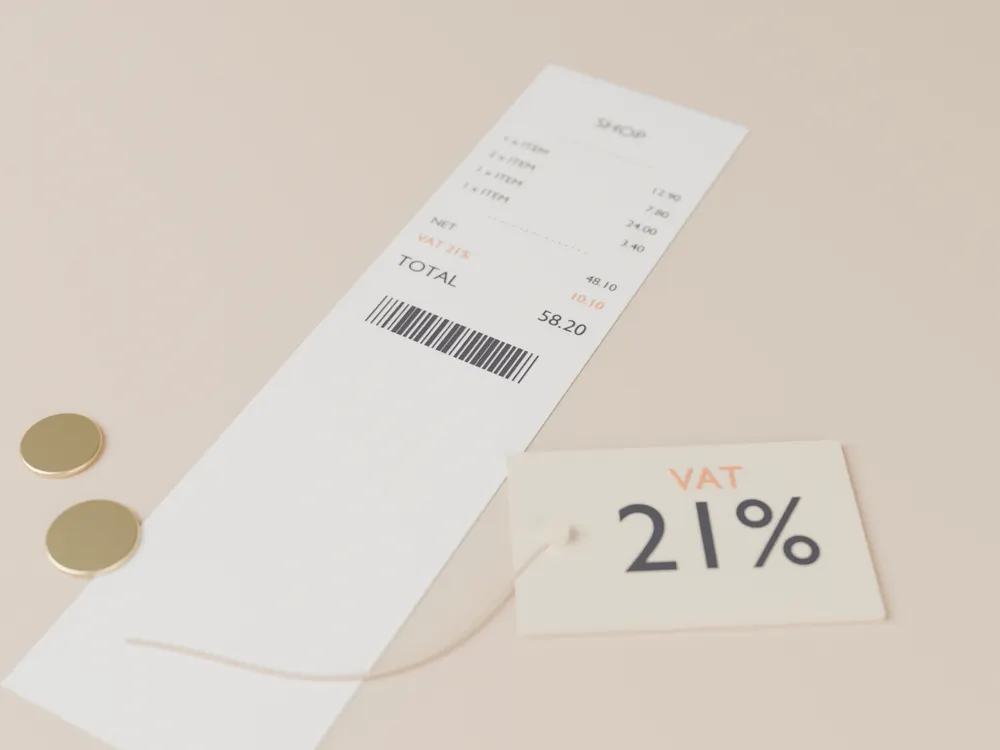
From the price tag to the receipt
100.00
net100.00VAT 21 %21.00gross121.00
Rates by type of goods and services
| Food | 9 % |
|---|---|
| Medicines | 9 % |
| Medical equipment and aids | 9 % |
| Books | 9 % |
| Newspapers | standard rate 21 % |
| Magazines and periodicals | standard rate 21 % |
| Passenger transport | 9 % |
| Hotel accommodation | 9 % |
| Restaurants and catering | 9 % |
| Cultural events and museums | 9 % |
| Sporting events | 9 % |
| Water supply | 9 % |
| Electricity | standard rate 21 % |
| District heating | standard rate 21 % |
| Natural gas | standard rate 21 % |
| Social housing | standard rate 21 % |
| Home renovation | 9 % |
| Solar panels | 0 % |
| Hairdressing | 9 % |
| Child car seats | standard rate 21 % |
| Medical and dental care | standard rate 21 % |
| Social services | standard rate 21 % |
Categories without an entry have no reduced rate listed, so the standard rate applies.
Notes from the EU database (in English)
- Food: Tabel I prov. a.1: foodstuff for human consumption, products used for preparation of human foodstuff that are wholly/partially incorporated in these foodstuff, supplements/substitutes for human foodstuff; Excluded: living animals, except if consumed raw.
- Medicines: Tabel I prov. a.8: bandages such as cottonwool, mesh, adhesives, band aids, tampons, splints and similar products for pharmaceutical purposes; first aid kits; sanitary napkins; maternity matrasses; incontinence products; products that with regard to use can be equated with said bandages and are developed and offered for medical purposes. 'Bandages' only encompasses products that serve to cover injured body parts. Excluded: consumer articles (such as clothing) which have a therapeutic effect. · Tabel I prov. a.6: medicines as referred to in article 1-1-B of the 'Geneesmiddelenwet' (Dutch 'Medicine Act') for which a marketing authorization as referred to in article 1, section III of that act has been granted or for which a marketing authorization is not required pursuant to article 40-3-A to G of that act; contraceptives; infusion fluids; kidney dialyses concentrates; and inhalation gases apparently intended for medical purposes. · Tabel I prov. a.7: veterinary medicines as referred to in the 'Wet dieren' (Dutch 'Animal Act'), which are used in or on the animal itself (in vivo use). Excluded: products that are necessary to make a diagnosis and that are applied to tissue or body fluids originating from animals (in vitro use) are excluded; products that are used in the animal's living environment.
- Medical equipment and aids: Tabel I prov. a.35 and b.1: artificial limbs; devices for taking over the fixation function of a malfunctioning hand; leg braces, fracture bands, artificial joints; artificial eyes, -ears, -kidneys; certain prostheses; heart and muscle stimulators; hearing aids; stuttering ear aids; aids for stoma patients; orthopedic footwear; devices for taking off therapeutic elastic compression stockings; orthopedic corsets; parts, components and accessories apparently intended for the aforementioned goods · Tabel I prov. a.31 and b.1: certain braille products; clocks, optical reading devices, TV magnifiers, reading platforms, orientation aids, support, tactile and recognition canes designed for personal use of blind and partially sighted persons; guide dogs; other aids designated by ministerial regulation that have been specially designed for exclusive and personal use by blind and partially sighted persons; reading pens and other equipment with similar function, equipment for use by dyslexics. · Tabel I prov. a.34 and b.1: carriages and crutches for the disabled; stand-up chairs; high-low beds. A vehicle for the disabled is defined as a means of transport that is designed to be used by a disabled person. The term can also include motor vehicles which are equipped for use by a disabled person. Only carriages that within social standards are regarded as a vehicle for the invalid on the basis of its destination and presentation are included. · Tabel I prov. a.36 and b.1: aids that are usually used for the subcutaneous administration of insulin, with the exception of syringes and needles that are apparently also suitable for other purposes; aids that are usually used for the self-diagnosis of blood sugar levels. Only included are the mentioned devices specifically developed for diabetics and offered as such. Generally applicable aids such as individual injection needles and syringes are excluded. · Tabel I prov. a.37 and b.1: measuring equipment and accessories for self-diagnosis of the coagulation time of blood; drug nebulizers; catheters; urine bags; allergen-free covers; anti-decubitus mattresses; portable infusion pumps; oxygen concentrates and accessories, and carrying straps or bags specially designed for personal mobile use for an oxygen cylinder or oxygen container; computer mouse software, whether or not supplied by electronic means, specially developed for users with tremor.
- Books: Tabel I prov. a.30, b.2, b.21: digital or physical supplies (including on loan of): books; digital educational information that is provided on physical carriers and that is apparently intended exclusively or almost exclusively for the transfer of information in education; newspapers, weeklies, magazines and other publications appearing periodically at least three times a year.
- Passenger transport: Tabel I prov. b.9: private bus transport; public transport and taxi transport as referred to in Article 1 of the 'Wet personenvervoer 2000 (Dutch 'Passenger Transport Act 2000'), taxi transport of persons by road other than by car, and the transport of persons by aircraft if the place of departure and the place of destination are located in the Netherlands insofar as this transport takes place by balloons or by aircraft equipped for the transport of ill or injured persons;
- Hotel accommodation: Tabel I prov. b.10: providing the opportunity to camp within the context of a camping and holiday business to persons who only stay there for a short period. The term "camp and holiday business" should be interpreted according to parlance. It is not required that the lessor provides the additional services that camping sites normally provide. 'providing the opportunity to camp' must also be interpreted according to parlance.
- Restaurants and catering: Tabel I prov. b.12: serving out foodstuffs for human consumption, for use on site within the context of a hotel, café, restaurant, guesthouse and related businesses. The supply of freshly prepared food or edible products for immediate consumption in snack bars, snack vans, cinema foyers, sports club canteens and such is considered a supply of goods, unless the services accompanying the delivery of the foodstuffs predominate.
- Cultural events and museums: Tabel I prov. b.14 to b.15: granting (physical) access to circusses; zoos; public museums or collections (including closely related supplies of goods, such as catalogs, photographs); music and stage performances, including lectures (excluding peep shows/other performances primarily aimed at erotic entertainment); cinemas; amusement parks, playgrounds and gardens, other facilities primarily and permanently furnished to entertainment and day recreation.
- Sporting events: Tabel I prov. b.3 and b.14, f: the granting of (physical) access to spectators of sports competitions, demonstrations and the like. Sports competitions are events where people actively participate in sports. Sports demonstrations are, for example, shows of the Harlem Globetrotters (basketball), performances of the Spanish Riding School (horse dressage) and shows of Wrestlemania (wrestling); use of sporting facilities.
- Water supply: Tabel I prov. a.28: including water supplied via the public mains network; distilled water; warm water; and 'other water' (surface water not suitable for human consumption but usable for non-consumptive purposes such as rinsing activities or sprinkling crops). Excluded: demineralized, deironed and softened water; river water and sea water (2501 00 10) whether or not intended for scientific purposes; ice and steam.
- Home renovation: Tabel I prov. b.19: the application of energy-saving materials to floors, walls and roofs of housing in use for more than 2 years, when this service is aimed at making housing more energy-efficient. Structural components such as windows and doors are a normal part of housing and as such are not insulating material. Excluded: the supplies of materials which account for part of the value of the included services. · Tabel I prov. b.8: Painting and plastering of private dwellings (i.m. intended for permanent residence by individuals) more than two years after first use. Painting: processing and application of paint or painting system (whole of activities associated with the pre-treatment of a specific surface and subsequent finishing of that surface with specific paint products.) Plastering: preparation and pre-treatment work a plasterer performs before proceeding to actual plastering; plastering.
- Solar panels: Tabel II prov. a.10: A zero rate is applicable for the supply and installation of solar panels [panels that have the function of generating electricity from sunlight with photovoltaic cells (also known as PV cells or solar cells)] on and adjacent to private dwellings. An important condition for the 0% rate is that the panels are installed on or near a home.
- Hairdressing: Tabel I prov. b.7: activities a hairdresser usually performs on human hair (cutting, washing, blow drying, dyeing, shaving etc). Products that hairdressers use when treating hair ( shampoo, hair dye, etc.) and inexpensive hair ornaments incorporated into a hairstyle that are not separately charged and application of hair extensions and measurement and overhaul of wigs and toupees are also included. The material used for those services (hair extension, wig or toupee) is excluded.
Reference only: the binding rules are the national VAT laws. The EU database is informative and may lag behind national changes.
Other countries
- Austria 20 %
- Belgium 21 %
- Bulgaria 20 %
- Croatia 25 %
- Cyprus 19 %
- Czechia 21 %
- Denmark 25 %
- Estonia 24 %
- Finland 25.5 %
- France 20 %
- Germany 19 %
- Greece 24 %
- Hungary 27 %
- Ireland 23 %
- Italy 22 %
- Latvia 21 %
- Lithuania 21 %
- Luxembourg 17 %
- Malta 18 %
- Poland 23 %
- Portugal 23 %
- Romania 21 %
- Slovakia 23 %
- Slovenia 22 %
- Spain 21 %
- Sweden 25 %
- United Kingdom 20 %